Lately I’ve been working on hard projects and this leaves me exhausted. Mentally exhausted from thinking about career and what aspects of lifestyle I desire. Consuming sustainability and gardening tutorials through books and YouTube videos contributes to the chatter in my mind. It’s all in my head, but it makes me tired.
What I’ve found to be helpful is:
Rest – sleep enough hours, or even an hour or two more than usual. Go to bed around the same time, take naps when needed.
Eat healthy – an occasional main or side salad harvested from the garden, a colorful vegan meal, homemade baking even if the muffins sink in the middle and look funny.
Exercise – go on walks, even just for a few blocks. You won’t get that wet if it’s raining a little.
Decompress – talk to someone who is a good listener, or write about the chatter in a journal. Getting it out helps. Being able to pen down a looming worry onto a few lines on paper shows that it’s not too big to be written about, and therefore can be managed bit by bit.
Here’s to working towards big goals and resting along the way!
Tip: This photo is of some “living lettuce” I bought at the grocery store and replanted. These come with the roots intact and last longer in the fridge. Enjoy most of the leaves, save the core of innermost leaves and roots intact, and plant in soil. It’s a similar cost to buying seedlings (about $3 for 3 lettuce plants), plus you get to enjoy more harvest before planting!
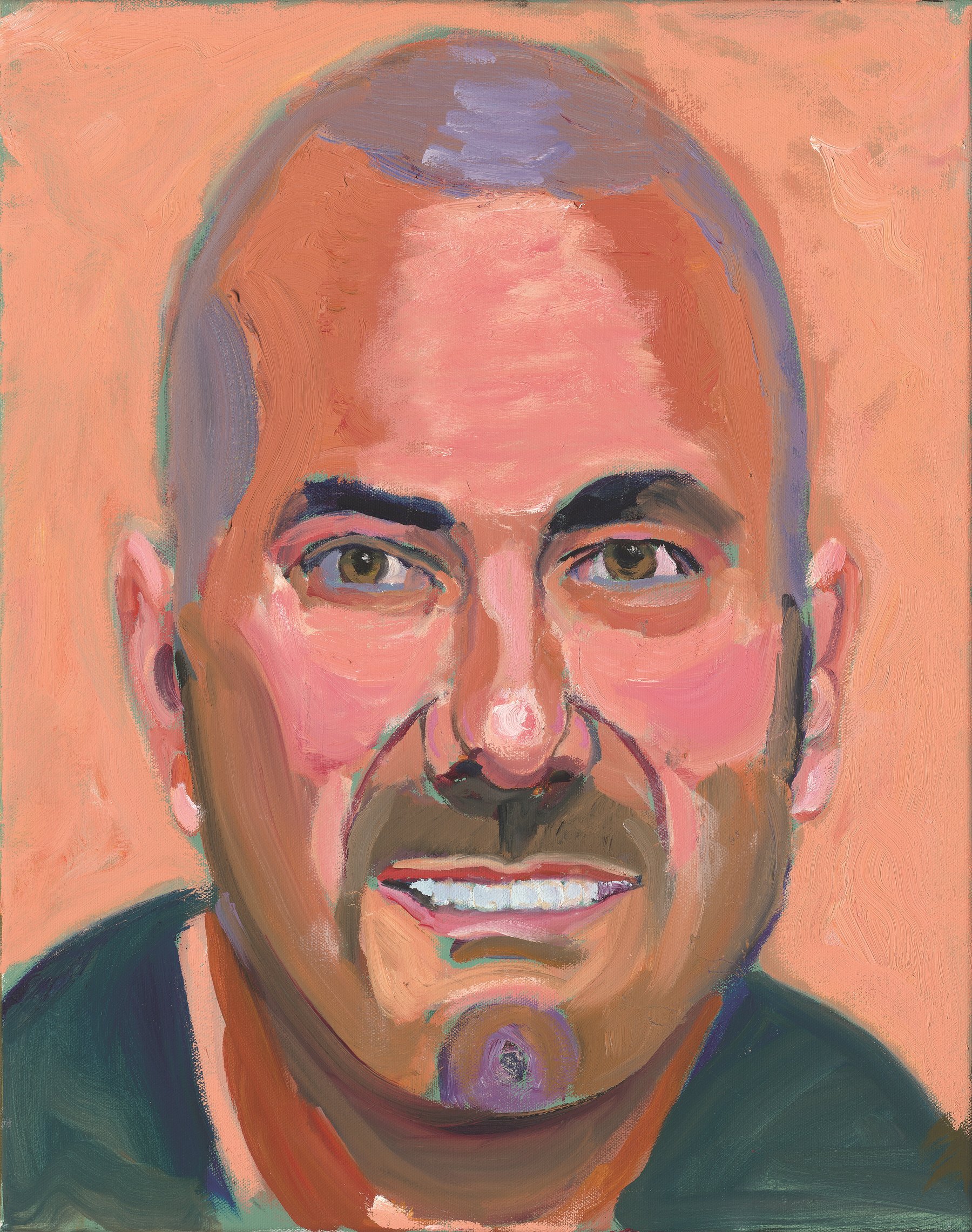
I’ve been enjoyed listening to George W. Bush’s audiobook, Out of Many, One. It is a diverse collection of stories and portraits of various immigrants to the United States, read by the former president in full Texan glory.
At the end of each story, the featured person describes the American dream in his or her own words. One particular man’s definition, Mark Haidar, struck me deeply. So deeply that I re-wound and repeated his section 3 times while audiobook-listening and lock-picking one evening. So deeply that I also repeated his chapter twice the next afternoon. So deeply that I don’t have a copy of the e-book, but I listened and transcribed his American dream for you too to enjoy. I hope it resonates with you.
Oil portrait of Mark Haidar by George W. Bush
My name is Mark Haidar. To me, the American dream means freedom.
I guess for me it all started when I read the declaration of independence and the promise of life, liberty, and the pursuit of happiness. As a 12 years old boy that had none of the 3, I gravitated toward that promise. I wanted to live life in liberty, pursuing happiness. As a person with an entrepreneurial spirit, I gravitated toward that.
The journey to becoming an American was joyfully arduous, and to me becoming an American is the greatest honor to have. It is simply because of what being an American and what the American dream means to me, and it means a lot of things. The American dream is not about having a house in the suburbs, a job, and a car. You can have that anywhere in the world, or at least in a lot of places in the world.
Out of Many, One – by George W. Bush
The American dream is about having a voice, rather than an opinion. The American dream means you have access to opportunity, but without a guarantee for success. The American dream means that you’re compassionate and care about other humans. The American dream means that you reward hard work. The American dream is being a doer, not just a thinker. It is about bringing ideas to life, and not just talking about them. The American dream is believing in yourself and what you’re capable of doing. Most of all, the American dream is about the fact that you’re allowed to dream big. But more importantly, that you’re allowed to fail, miserably.
Immigrants understand what the American dream is all about – that’s because they grew up dreaming it! And when they’re here, they don’t take it for granted. They work for it. To them, the American dream is something to be earned and not given. An immigrant is an American by choice, and not by birth. An immigrant – you have to make a lot of sacrifices, leaving your family, friends, your safety net, your language, and home behind. Leaving everything you know to start from scratch. You do that because you believe in the American dream. Because you believe that being an American is worth fighting and sacrificing for. That’s why immigrants work hard to contribute to America. But also, they bring with them a fresh set of eyes, traditions, perspectives and ideas that enriches our thinking and makes us more diverse.
My advice to the young immigrants coming here today would be: Don’t expect America to be perfect. But know that it is the most imperfectly perfect country in the world.
The road to citizenship will not be easy, but I haven’t seen anything great that wasn’t hard.
Last night, I read a picture book called “Yara’s Amazing Nose”. How many books have you read about tapirs? (pronounced like tah-PEER, not like a taper candle!) I became more curious about this pig-elephant-hippo-like creature, so I searched on YouTube to learn more.
Most YouTube results showed tapirs in zoos, or “8 awesome facts about the tapir!” which didn’t satisfy my snout-shaped curiosity. I wanted to know about how they live in their habitat, if they roam peacefully or are boisterous, how they differ from javalis (ha-va-LEES, jungle pigs), and how they use their nose.
Then it occurred to me — to the English-speaking world, tapirs are mostly unheard of, and documentaries are sparse. What if I searched for results in Spanish? “Que es tapir” I typed in. Lo and behold! Rich documentaries from the Colombian and Mexican forests with footage of tapirs roaming and sniffing around their native habitat. The descriptions were much richer. I learned that tapirs are solitary (unlike javalis), they love eating a variety of fruits, leaves, and seeds, and are important in dissemination of seeds around the forest. Their diet is healthier than mine! They like to roam large areas of forest and water, and have 14 toes in total. They are known as ‘danta’ in Mexico and ‘tsíimin’ in Maya. They’re only natural predators are the jaguar and puma, but poaching and deforestation for farming have made their population endangered. There’s only about 5,500 of these tranquil creatures left in the wild.
I enjoyed learning about the tapir. This also reminded me to consider searching for information in another language I know, to make the most of the both worlds!
There are some ideas and cleaning recipes that sound crazy to me. Such as:
Making your own toothpaste, and oil-pulling (swish oil in your mouth for several minutes)
Not using shampoo (my scalp feels itchy just imagining this!)
Wearing the same outfit every day
They sound crazy because they seem hard. I want to try some things like these in order to see if it’s possible, but I fear I won’t enjoy the transition or will feel unclean or unhappy.
I will say, however, that I’ve done some things that past year that were on my DIY crazy list that were actually not so hard and even enjoyable:
Grew my own tomatoes – 3 kinds! And daikon, lettuce, kale, one jalapeño, and strawberries
Made kombucha using home-grown strawberries and foraged Italian plums and blackberries
Made decent cappuccinos with foamed milk (next up: latte art)
Roasted coffee
Made homemade surface cleaner & window spray that works (alcohol, castile soap, eucalyptus oil, corn starch)
Maybe one day, the things that sound impossible to me will feel normal!
Look for where your privilege intersects with somebody’s oppression.
That is the piece of the system that you have the power to help destroy.
-Ijeoma Oluo
I’m starting to see that being passive, going with the flow, and pretending everything is alright does not help in combating racism. Combating racism requires taking an active stance against problematic behavior and statements. It requires being deliberate and actively working to build diverse communities, full of color and culture. It applies not only to others, but also to myself.
Most of the time, we do not recognize our own privilege. We do not realize the things which we have grown so used to. How many breaths have I inhaled in the last 2 minutes? What are my feet doing right now? Do I sleep in a safe environment at night?
I want to find where my privilege intersects with somebody’s oppression, and work to help break the oppression and lift everyone up.
I started jogging / running this year, and picked up a guide on training for Triathlons on my way home from an evening run. I skipped to the section on running advice for beginners, and one tip stuck out to me.
Run by time, not by distance. It’s easier to measure how many minutes you’ve run than it is by distance. For example, run 3 minutes, then walk 1 minute. Repeat 3-5 times, then call it a day.
Some days we run better, and some days the legs are just harder to move.
By setting goals by time rather than distance, we can still guarantee we got some jogging in, rather than getting hung up that we didn’t quite run the full mile we intended.
It also happens that my secondhand, 10-year old Garmin Forerunner watch takes many minutes to boot up the distance-tracking/GPS mode. Sometimes I’m halfway through my run by the time it’s booted up! The timer option doesn’t require booting up so I sometimes just go with that. I aim to run about 1 mile each time I go out, but when I measure by time, I don’t get so hung up on whether I met that distance or not. I feel physically good after running and mentally don’t look for reasons to lament that it ‘wasn’t enough’.
I’ve been applying this lately to work, too. There’s something called the Pomodoro Technique where you work in blocks of time, then take a dedicated break (you’ve earned your tomato!), and repeat. Even if the task isn’t completed during the block of time, there was still progress made. I think it’s key to experiment and find what block length keeps you motivated.
Currently, I find 30 minutes of work, then about 10-15 min of break works well. 30 minutes is bite-sized enough that I’m willing to get started, knowing the finish line is in sight. This has helped with self-disciplining my productivity while avoiding becoming burnt out, eyeballs glazed and back aching by the end of the day.
What are ways you make your goals more bite-sized and thus attainable?
Tiny turkey-tail-like mushrooms growing on a tree, Bellevue Botanical Garden parking lot
Have you ever noticed how rare it is to find a personal blog that lasts for several years, with new posts published regularly?
Many a time I have searched a topic on Google which led to a helpful blog post on the topic, say about a grammar rule, a specific restaurant, or exotic fruit. A memorable or funny post will have me browsing the archive to see what else the blog writer has published. Often, if the post is from 2005 or 2015, there will be no more posts after a year or two. I guess it’s hard to keep up a blog. It’s natural to get distracted or lose interest in maintaining it.
I recently came across one blog that is, stunningly, updated with a new post *every* day. It’s The Opportunity Machine, written by a wise and funny guy named Johnny Roccia. I first visited his blog on February 23 and saw there were (23) posts on the right-hand panel. What! Could that be right? And lo and behold, I discovered perhaps the most consistent blogger to grace WordPress. His posts are succinct and they don’t necessarily strive to deliver life-changing messages every time. I don’t know what motivates Johnny, but his consistency is admirable and inspiring. I suspect that he writes daily for his own sake rather than trying to satisfy an audience of followers.
In that spirit, I’ll be writing these next few weeks (hopefully months or even years) about different things that are floating through my mind. They may not appear to have a consistent theme, but that will naturally come as I figure out what topics are enjoyable to blog about. Thank you for reading, and welcome to Nest Cafe!
The textbook for my AP Environment Science class was dense with small print, depressing statistics, and heavy cynicism. It was critical of humans, citing overpopulation and human behavior as causes for environmental problems. It made the reader (as a human) feel guilty for existing!
Some of the environmental topics have stayed with me many years after collecting sample water from the wetlands to measure dissolved oxygen levels, or memorizing the top 10 countries’ annual CO2 emissions. I am increasingly reminded of them while also fiercely wanting to believe in hope for the future of our physical environment, and that people are doing something about it.
I started researching areas in agriculture/food production where innovations are being developed to improve farming practices and reduce the harmful impact on the land, air, water, and human health. Here are a few that were new to me and exciting to discover — I hope you learn something new, too.
Precision Farming – Professor George Vellidis works with graduate student Anna Orfanou on checking the circuit board of a University of Georgia Smart Sensor Array node. (Photo by Andrew Davis Tucker)
Precision Farming (Precision Agriculture) Source: https://gca.org/this-is-how-farmers-are-using-satellites-to-enhance-adaptation-2/ Area: Agriculture and Technology Who: Private companies and start ups, farmers What: Using tech tools like GPS, ArcGIS, satellites, drones and sensors to better understand land and improve efficiency (use less fertilizer, better-tailored irrigation, use algorithms to optimize crop yield based on soil quality). Current challenges: “Poor internet coverage, inability to afford the set-up costs of apps and services, and a lack of technological know-how among farm workers have all been cited as barriers to uptake. This will be even more of a challenge in the developing world.” Example companies: Ag Big-Data Firms, such as True Harvest, Discovery by Farmlink, and many examples listed starting at 2:07 in this video: https://www.youtube.com/watch?v=581Kx8wzTMc
Climate-smart Farming Source: https://gca.org/how-climate-smart-farming-is-bringing-jobs-back-to-nepal/ Area: Agriculture Who: Government, smaller farmers What: Uses “simple” (less high tech than precision farming) solutions that work with current climate conditions to improve farming. For example, Nepal has a monsoon season which means there is sometimes very heavy rainfall that washes away crops. Provide subsidized tanks to farmers which can capture rainfall and distribute irrigation water. Or, set up plastic ‘tunnels’ to cover tomato plants and protect from blight. Provide drought-tolerant seeds and hybrid goats that are hardy to the environment. Educate village farmers on soil mulching, rainwater harvesting.
Vegan Farm Transitioning Source: https://gca.org/how-making-the-switch-to-plant-based-milks-can-support-farmers-and-ease-water-scarcity/ Area: Agriculture, Ethics – Veganism Who: Private companies, not-too-small farms What: Help farmers in struggling traditional industries like cow milk production (milk value has been falling) to set up fields for plant-based milks like oat milk, which have been rising in demand and value. Some farmers dedicate 1/4 of their land to plant-based milks while maintaining their dairy-cow business. Some brands like Elmhurst completely transformed to producing plant-based products. Example Companies: Hood, Elmhurst, Oatly, Planet Oat, Miyoko’s Creamery
Impact: Much less land, water, and emissions are used to produce each cup of plant-based milk than cow milk. In order for a dairy cow to produce milk, the cow must be pregnant and give birth (usually then separated from her calf) for her entire milk-producing life. To me, this is deeply concerning as the cow suffers an exhausting life just for the utility and pleasure of humans. This fate would not be acceptable for a human mother, so I do not believe it is just to impose this on any animal mother.
Technology and scientific innovations to improve plant-based milk taste & shelf life, and lower cost Source: https://elmhurst1925.com/blogs/news/benefits-of-shelf-stable-plant-milk Area: Food Processing Technology, Ethics – Veganism Who: Private companies What: Innovations that help improve the flavor, creaminess, and durability of plant-based milks. Impact: This will bring more consumers into the plant-based milk world as products become tastier and (I hope) eventually cheaper than their dairy-milk options. Examples: Elmhurst’s HydroRelease (TM) to preserve nutrients and flavor without gums and thickeners, Aseptic packaging (packing milk in air-less vacuums, so milks last for months when unopened and not refrigerated in their cartons)
Increasing Accessibility: Getting cafés to carry more vegan milks without costing extra No source here – just an idea budding in my mind. I’ve long been bothered by the $0.50 surcharge for requesting soy milk in my cappuccino. I don’t think the business is paying 50 cents more per foamed soy milk cup than for 2% milk. It feels like the consumer is being punished for choosing a healthier option, and I’m sure this deters many customers from even considering a plant-based milk option in their drink.
When I lived in Peru, finding a cafe that even offered a plant-based milk option was rare to behold. And that’s how it used to be elsewhere, including the United States — at first, cafes and grocery stores didn’t carry them, and when they started, they had premium cost.
Eventually, I hope that the supply and demand of plant-based milks will rise so that they are readily available and do not cost extra, as the cost of producing cow’s milk (raising the cow) is higher than growing a plot of soybeans or oats.




 Nest Cafe ~ Cafe Nido