Mandu 만두- Korean dumplings recipe

The cooler temperatures of fall awaken my craving for juicy steamed dumplings, which are called mandu (만두) in Korean. Mandu (만두) is fun to make together with family members. Traditionally Koreans do not use recipes and make things “to taste”. This is based off of my family’s northern-style “recipe” for large, steamed or boiled mandu – these are not meant to be fried. The taste is milder than typical fried gyoza and warms the soul.

Yield: 64 pieces, 2250g, about 8 servings of 8 만두 each

Ingredients:

속 Filling:

  • Ground Pork 1 kg (can also do ground beef, or half-half beef and pork)
  • Firm tofu, 1 to 1.5 blocks (1 block = 1 square package)
  • Green cabbage, 1/4 – 1/3 head, diced
  • 부추 garlic chives, 1 bundle, rinsed and diced. (Diced Frozen OK)
  • Minced garlic, the more the merrier (at least 5 cloves)
  • Ginger, finely minced, about ½ thumb-sized amount
  • Sesame oil
  • Salt and pepper to taste

 만두피 Wrapper:

Round, pre-packaged dumpling skins, at frozen section at Hmart. For 1 kg of ground pork, I used (2) 310g or 10.9 oz packages.

양념간장 Seasoned Soy sauce:
No measurements, make to taste

  • Soy sauce, Sempio 701 is the best
  • Sesame oil
  • Sesame seeds, toasted white
  • Garlic, minced
  • Chives
  • Gochugaru chili flakes, 1 pinch

Tools:

  • Disposable glove
  • Large bowl
  • Trays
  • Steamer (I use a large pot + silicone steamer rack)

Directions

  1. Defrost mandu skins and any frozen ingredients.
  2. Mince all veggies
  3. In a large bowl, mix the ground pork and tofu. A gloved hand is best. Then mix in remaining filling ingredients.
Raw filling and wrappers
  • Take a spoonful of filling and fry. Taste the level of salt. It should taste slightly saltier than desired for final product. Adjust salt to taste.
  • Set up ‘mandu filling’ station on a dining table with bowl of water, trays, mandu skins, fillings, and 1 spoon per person.
  • Wet fingertip with water to moisten the edge along one mandu skin.
  • Fill in the mandu skins and fold. Watch a video for how to do this. Each family does this slightly differently.
  • Place folded mandu on tray.
  • Steam or boil in broth, and serve with seasoned soy sauce.

Preserve:
Freeze mandu on trays so they don’t stick together, then move frozen pieces into large ziploc bags. Steam or boil frozen mandu when desired.

Variations:
Make the wrappers from scratch. My family is loyal to 곰표-brand flour.
Add 당면 noodles to the filling.
Adjust the ratio of meat to tofu 두부.
Add other diced veggies to filling like shiitake mushrooms.

Folded mandu on a tray, ready to freeze or be steamed!

Pantographs and brains

In an electric vehicle charging system, the pantograph structure lowers onto a bus roof to charge the batteries.

The charger is physically a large electrical cabinet, over 6 ft tall. An electric vehicle charger cabinet is connected to 1-4 pantographs.

A colleague said that “pantographs don’t have a brain”. So technically they don’t have their own power rating – it’s the charger that delivers power, not the pantograph itself.

Does this imply that the electric vehicle charger has a brain?
That the brain is a computer?
That a computer is a brain?

I don’t think so, but these are cool to see.

Two red pantographs that are lowered to charge electric bus batteries on the bus roof.
The “Brain”. Inside look at one side of a charger cabinet. These are large and complicated.

Notion, the 3rd generation

I’ve started using Notion to jot down notes and ideas and turn them into task-lists. It’s been most useful to replace locally-saved OneNote for my Python and Azure study notes, because I go between my work laptop and home PC frequently.

I see a lot of potential with this tool. It loads faster than Google docs, allows image pasting and emoji insertion, is free with no ads, and so far has been mostly intuitive. Because it’s cloud-based I can access my Notion notes from any computer or phone with internet connection. I’m excited to explore how to use it better, to jot down the ideas swirling in my head and turn them into manageable to-do lists and productivity journal. Heck, I want to try Notion for Nest Cafe blog post outlines too!

Akshay Kothari, Notion co-founder, describes this potential well:
“We hope that Notion becomes the third generation of productivity software, after Microsoft Office and Google Suite. We’re much more powerful in that people will be able to not just take notes and manage projects, but will be able to create things that work the way their brain works.”

How do you like to use Notion? Feel free to share in the comments any tips, lessons, or templates that have been useful to you.

How to Install a Printer: Dell B2360dn Mono Laser

Connecting a printer to your computer is sometimes tricky. I got a used black & white (“mono”) laser printer and my computer could not recognize it despite connecting it by the USB cord. Here’s how I finally figured it out. These steps should generally work for adding any older home printer with a USB cord to your laptop or computer, not just the Dell B2360dn Mono Laser printer.

Step 1: Turn devices on. Plug in your printer and computer and power them both on. Connect the printer to the computer by USB cable.

Step 2: Download the printer driver.
https://www.dell.com/support/home/en-us/product-support/product/dell-b2360dn/drivers

Search online for your printer brand + model + driver. That should lead you to the official printer brand’s website where you can search for your specific model, then download the corresponding driver for free.

I downloaded the driver for “Dell Printer Driver for PCL5e…” from this list because the File Name contains “signed” (UPD v3 APW Driver Package_signed – PCL5.zip).

The driver is a software that helps the computer recognize and connect to the printer hardware. These are sometimes downloaded automatically upon plugging in a printer and having internet connection. But for some older printers, these are not automatically downloaded.

Step 3: (for Windows 11) Open Windows search bar, type “printer” > choose “Printers & Scanners” or “Add a printer or scanner” > Add Device > wait a few seconds as it searches, then “Add Manually”.

The printer is not detected by the computer and does not appear on the refreshed printer list, so we will add it manually.

Step 4: Choose the last option in the new popup window, “Add a local printer…with manual settings”.

Step 5: Choose “Use an existing port:”, then select your printer from the drop down list > Next.
Troubleshooting if printer not in drop down: Make sure the printer is on and connected by USB cable to the computer.
This is how I confirmed my printer make & model name.

Step 6: Install the Printer Driver you previously downloaded.
I selected Dell on the left side, then “Have Disk”, and pointed it to the signed driver file downloaded in step 1 that ends in ‘.inf’ file extension.
This is where I read about ‘digitally signed’ drivers and thus opted for the signed option from the Dell website. I had to dig a little amongst the downloaded driver files to find the one ending in .inf. In this case it was DKUD1o40.inf.

Mission complete!
Your printer’s driver is now installed and it should show among the printers list. Happy Printing!

Fall Eggies: Aug, Sept Oct 2024

Last night (just after Thanksgiving) there was a solid frost blanketing the grass and tree branches. I broke up a top crust of ice in the hens’ water bowls. The hens are going to roost with the sunset around 4:40pm and rise at 7am, so they are sleeping well over 12 hours. These are the signs of late fall and winter.

Here is the egg count for the year thus far:

Month
(2023)
Laying
Hens
Eggs per Day (avg)Eggs per WeekDozens per WeekEggs per MonthDozens per MonthFeed CostCost per Dozen
Oct5.254.0292.412510$ 30$ 2.85
Sep64.6332.813711$ 30$ 2.60
Aug75.6413.417515$ 30$ 2.04
July75.8423.517915$ 30$ 1.99
June76.2453.718615$ 30$ 1.92
May7.256.2453.719216$ 30$ 1.86
April7.255.8423.517314$ 30$ 2.06
March7.54.5322.713812$ 30$ 2.58
Feb53.8282.31079$ 30$ 3.33
Jan3.52.7191.6837$ 30$ 4.30

The “Laying Hens” count is now corrected, which I forgot to do in previous posts. 3 hens have been molting this fall: Waffles, Shaki and Tots. I’m surprised Tots is molting at just one year old, which I realized when she became unusually skittish to the touch and started losing head and tail feathers. The partial hen counts mean that a hen stopped laying (started molting or Nuggo’s henopause) for part of a month.

There is a noticeable decline in egg laying. I now sometimes buy eggs to supplement. I always thought that my hens’ eggs were on the smaller-side compared to large supermarket eggs, but pleasantly found ours to be as big or bigger than large eggs by weight.

I am also perplexed why the 2 year old hens (Brownie, Blanqui, Ramsey) haven’t noticeably molted nor paused laying eggs. Are some barnyard mixes or hybrid varieties capable of not molting?

It’s reassuring that even though our winter egg count is low, the cost per dozen still beats the price of organic-fed, cage-free eggs at Costco or supermarkets. I believe our hens live out better qualities of life than those from best eggs at a premium grocer because their beaks are never trimmed, they can forage bugs (so many worms in the rainy season!), enjoy organic garden veggies, fruits, and grass, and have a large area per bird to roam around. The most comparable brand I have encountered so far are Wilcox Farms pasture-raised eggs (by taste) and Vital Farms Organic Pasture Raised Eggs, but my babies’ eggs have the plus that they don’t require any trucking or logistical delivery to our kitchen.

I want to raise chickens forever!
– Korean Chicken Tender

NumPy vs pandas: .nanquantile(), axis = None

I love Python, particularly pandas’ rich library for data wrangling and mathematical functions.

But today I encountered a limitation of pandas. And it’s predecessor NumPy came through.

I wanted to calculate the average, median, and count of non-null values in a dataset. My dataset is messy and I need to calculate over different columns that aren’t adjacent to each other. For example, I want the average, median and count of all the values in columns 16 and 20. Not 16 through 20. Not the average of column 16, and the average of 20. One single average for the values in both columns 16 and 20.

This is where the “axis” parameter comes in. It usually defaults to axis = 1, ie df.mean(axis = 1), to indicate we are performing the calculation over a single column. For pd.mean(), I used axis = None to get a single mean over two non-adjacent columns. (double-checked it in Excel!)

import pandas as pd
import numpy as np

# df is the dataframe of my full dataset. Here we'll work with a subset of two columns, rows 4 through 54.
hello = df.iloc[4:55, [16, 20]]

# Get mean of the two columns using pandas.mean
calc1 = hello.mean(axis=None)

But pandas doesn’t have an axis = None option for it’s functions to get the median or counts. It only has axis = 0 (over the row) or axis = 1 (over the column) as options, which is inconsistent with the .mean() option.

So this doesn’t work:

calc2 = hello.quantile(0.5, axis=None)
>>> ValueError: No axis named None for object type DataFrame

But hello NumPy! You do have axis=None available for these functions! So let’s import numpy.
My dataset has more than half of NaNs (null values) which I didn’t want to include for the median calculation. So I used np.nanquantile() in order not to count them. The np.quantile() function does count them and was returning a median value of ‘NaN’, which wasn’t what I wanted.

For the count function, we are getting a little creative by first counting all of the non-null values in the hello df (using pd.count()), then summing them up so that we can count across all multiple columns.

calc2 = np.nanquantile(hello, 0.5, axis=None) #numpy quantile allows axis of None
calc3 = np.sum(hello.count())

Thank you NumPy for saving the day! Although pandas is built on NumPy, I’m glad the libraries’ distinct features are all still accessible and that NumPy hasn’t deprecated.

I love Python! And now I love NumPy!

How to Import Tables with DataGrip

This is part 2 in continuation from the post Your Personal Database.

Now that we have a personal SQL database set up in DataGrip, let’s import our first data table. Note that this is for a personal database set up on a local computer. Not a shared database connected to an online server (which is what most companies or organizations would use).

Here’s how to import a table:

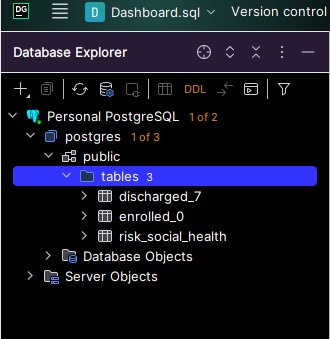
Step 1: Find the “public > tables” folder to which tables will get saved.
Starting with a fresh PostgreSQL database set up, this was located in postgres > public > tables.
If you do not see a “tables” folder, then use “public”. The tables folder will get automatically created upon importing your first table.
Do not use “Database Objects” or “Server Objects”.

Step 2: Right click on “public” or “public > tables” folder > Import/Export > Import Data from File(s).

Step 3: Select the data file to be imported as a table, then ‘OK’.
Make sure the file is closed. For example, do not have the .xlsx or .csv open in Excel on your computer, or else you will get an error.
Note how many rows of data the original file has (will use for validation in step 5).

Step 4: Set import format settings and set up SQL table.
Select the file format (top left corner).
Check “First row is header” if it applies (this is not checked by default).Z
Set the SQL table name (top right).
Review the header names (middle right). Double click on each and rename column names to lowercase with underscores replacing spaces in order to avoid using quotes ” to reference column names in SQL queries. You don’t need to redo this step when importing new data into this table in the future (but you can go back and edit).
Click “Import”.


Step 5: Validate that all data rows were imported.
A popup will appears in the bottom right corner showing how many rows were imported, and if any, how many errors were written.
Check #1: The number of rows imported should match what you expect from the original data file. For example, my data has 64 rows in the original CSV – (1) header row, and (63) data rows. So I expect 63 rows to be imported to the table.
If there were any errors, they were not imported into the data table. Investigate, fix, and re-import.

Step 6: Verify that the data looks right.
The newly imported table now appears under the “tables” folder on the top left corner.
Double click on this to view the table within DataGrip. Check that the data looks correct and as you expect.
Issues might include:
– Dates are blank or missing values (check that they have the right data type in Step 4, ie Date or Text)
– Too many rows: Old data on the table was not deleted, and newly imported data was appended on instead of replacing the old data

Step 7: Test it out!
See if it works!

SELECT * FROM new_table;

Happy SQL querying!

Blackberry Jam Recipe

In the Seattle area, invasive Himalayan blackberry vines abound with thorny branches and complex root systems. From my experience, these are the #1 most difficult weed to remove because the thorny branches always leave bloody battle scars, grow extremely fast, and it’s never clear how extensively the root system goes. Even their serrated leaves have thorny center veins!

But there is one silver lining! Once a year, at the peak of summer (usually late August), they yield a bounty of edible fruit with rich flavor and big seeds.

Walking back from the library, I scouted a blackberry patch on an abandoned lot. These berries grew with less exposure to car traffic and pollution being on a quiet residential street. I later set out with the hubby and big bowls to harvest as much as we could until we couldn’t tolerate the thorny pricks, stings and sticky berry juice stains any more. I blended the berries, strained out the big seeds through a sieve, and set out to make blackberry kombucha and enough preserves for the year. These can be enjoyed with plain greek yogurt or in baking.

For the first time, I got fruit jam to set! 2 full days after preparing the blackberry jam and putting some jars in the fridge, I tilted them and noticed they were no longer watery. Yes!

Here is the actual recipe I used, which is based on the tested Ball recipe from my pectin jar label. This was my first serious attempt at making jam and the result is good, but I don’t feel it’s good enough to share as a gift to neighbors or friends. I include notes for future recipe improvements.

Improvements for Next Time:

  • Use less water: There is a half inch of excess water above the set jam in most jars.
  • Use slightly less pectin: The jam is a little thick like jelly, whereas I’d prefer a spread.
  • Keep more seeds: I like a little more visible seeds
  • Try sugar instead of honey: There is a distinct honey taste. I don’t mind, but sugar is more neutral.
  • Add lemon or lime juice to add slightly more tartness

Ingredients

  • Yield: 12 half pint jars + a quarter pint
  • Total process time: 2 hours. Start a few hours before dinnertime!
  • About 2kg or 4.2lbs freshly picked blackberries, washed and rinsed
  • 14 tablespoons of low/no-sugar pectin (next time: try 12 tablespoons).
  • 2 cups or 500mL of water (next time: 1.25 – 1.5 cups)
  • 510g (about 3/4 of a bear bottle) of Organic Raw Honey
  • Next time: Juice of 1 or 2 fresh squeezed lemons

Tools

  • Pressure Canner (Presto Model 0178)
  • 12 quart stock pot
  • 12 Half-pint mason jars, canning lids and rings, sterilized in boiling water
  • Wide mouth funnel, canning tongs, hot jar wrench
  • Blender
  • Strainer
  • Boiling tap water to submerge jars in the canner
  • Timer

Steps

  1. Blend blackberries and strain out the seeds in batches. Pour fruit juice/non-seed pulp into stock pot.
    Note: The seeds comprised about 1/4 of my blackberry weight.
  2. Add some seed pulp back to stock pot, to taste or visual preference. I used 70g of seeds, next time try 150g of seeds.
  3. Heat berries. Bring berry stock pot slowly up to a boil, gradually stirring in pectin. Break pectin clumps and stir continuously. Bring to a full roiling boil that cannot be stirred down.
  4. Add sweetener and boil 1 minute. Sugar or honey. The blackberries are not sweet enough for my taste to make a true no sugar jam. Some day you’ll be hardcore. Add lemon juice here and taste test. Return to a full rolling boil for one minute (set timer).
  5. Remove from heat. No need to skim foam per Ball, it will go away!
  6. Follow canning directions to water bath 12 jars’ worth of delicious preserved blackberry jam, with a little extra (quarter pint) to enjoy without canning.
  7. Chicken snack. Feed excess blackberry seed pulp to chickens! They will love it, and you will love not having anything to throw away!

June & July Egg Eggies – Heat, harmony, & 6 a day!

It’s mid-August and the first heat wave has struck Seattle this summer. The highs are near 90 degrees and my back porch thermometer reported 96 degrees due to a greenhouse effect from the semi-transparent porch roof.

When it’s hot like this, with highs above 80 degrees, I check outside every hour or two to observe how the chickens are coping. They hold their wings apart from their body, pant, hang out in the shade in the north side of the house, eat less grain, and need their water bowls refilled twice dailyi. I give them kale and outer cabbage leaves in the evenings because their appetite for salad spikes. The older hens (las reinas) tolerate the heat best, while the youngest ones (las angelitas) pant and show signs of distress the most. Each year they learn to cope better.

I am grateful for these hens and the bounty of eggs they lay for us. Here’s the egg count for June, July and other months thus far:

Month
(2023)
Laying
Hens
Eggs per Day (avg)Eggs per WeekDozens per WeekEggs per MonthDozens per MonthFeed CostCost per Dozen
July85.8423.517915$ 30$ 1.99
June86.2453.718615$ 30$ 1.92
May86.2453.719216$ 30$ 1.86
April85.8423.517314$ 30$ 2.06
March64.5322.713812$ 30$ 2.58
Feb63.8282.31079$ 30$ 3.33
Jan62.7191.6837$ 30$ 4.30

Observations:

  • May was the peak of egg productivity with 192 eggs that month, costing $1.86 a dozen (organic, pasture-raised).
  • June is close behind with 186 eggs at $1.92 a dozen. It’s downhill from here due to the shortening daylight!
  • Longer daylight and sunny days induce egg laying, not warm temperatures.
  • Now, in early August, the sun rises about 2 minutes later and sets about 2 minutes earlier each day. I expect greater decreases in eggs for the remainder of the year.
  • Brownie and the two youngest hens (Misty and Tots) are finally living in harmony! After many months of Brownie spontaneously puffing up her feathers and terrorizing las angelitas, they now share moments of dust bathing and pecking at grass seeds within a few feet of each other. It’s wonderful to see your children getting along after months of bullying and fighting. Brownie was the lowest on the pecking order (Rank # 6), so I suspect she wants to make it clear to the newcomers she will not be outranked.
  • Tots glucks in fear every time Brownie gets near, which instigates anger and a peck attack. She has been getting better about staying calm and not becoming an easy target.
  • Tots and Misty still appear to be in equal rank, but occasionally they challenge each other and puff out their hackles (collar feathers).
  • Hens abhor equality, so Tots and Misty will likely have a fight and set their positions for Number 7 and 8 in the pecking order — they cannot both stay tied for 7th. It’s only a matter of time.
In harmony~